
Why Financial Advisors Hire Financial Writers (And What They're Really Paying For)
Most financial advisory firms don't wake up one day and decide they need a financial writer.
They start looking when something else is already bothering them. Marketing that never seems to gain traction, a pipeline that still runs almost entirely on referrals, a firm that does genuinely sophisticated work — but somehow can't communicate that online.
Advisors who spend half of every prospect meeting explaining what the firm does and why it's different, instead of just doing the work.
The frustration is real, but it’s the diagnosis that’s usually wrong.
The issue is usually that the expertise isn’t translating in the way you think it is. Your firm is excellent in conversations. Online, however, it's difficult to see the value that your firm provides beyond every other firm out there. And, in an increasingly online world, that missing piece is so important. The right prospects aren't finding you, and the ones who do find you aren't getting enough to go on.
That's exactly what a financial writer is actually hired to do: help the right prospects find the firm, understand what it does, and come to the first conversation already convinced it's worth their time.
Why Financial Writing Is Different From General Copywriting
Hiring a general copywriter to write about financial planning usually produces content that's technically accurate… and completely forgettable.
Financial services writing requires its own kind of fluency: a working understanding of planning concepts, familiarity with how compliance shapes communication, and an instinct for how your financially sophisticated prospects actually give their trust. That last one especially.
The way someone decides whether to hire a financial advisor is different from almost any other buying decision they make.
A general writer can explain what a Roth IRA is. A financial writer understands how to position a Roth conversion strategy to a business owner in a high-income year who's already skeptical of advisors. The audience, the context, and the stakes are completely different.
That specificity is so important because financial prospects are incredibly careful, especially as you move further up the ladder. They're trying to see your expertise before they ever get on a call. Writing that simplifies the complexity of your world without flattening the thinking behind it is what earns that trust.
What Firms Think They're Hiring For
When an RIA starts looking for a writer, the brief is usually straightforward: blog posts, a newsletter, website copy, maybe some LinkedIn content or SEO articles.
Those are the deliverables. They're visible, easy to scope, and easy to put in a contract.
What firms actually want underneath that is harder to articulate: better positioning online, a stronger first impression with prospects who don't know the firm yet, warmer inbound inquiries, and more trust built before the first call so the conversation can start somewhere useful instead of from scratch.
The deliverables are easy to name. The business impact firms are really after usually isn't, and the disconnect there is part of why a lot of content efforts fall short of what firms were hoping for.
What Firms Are Actually Paying For
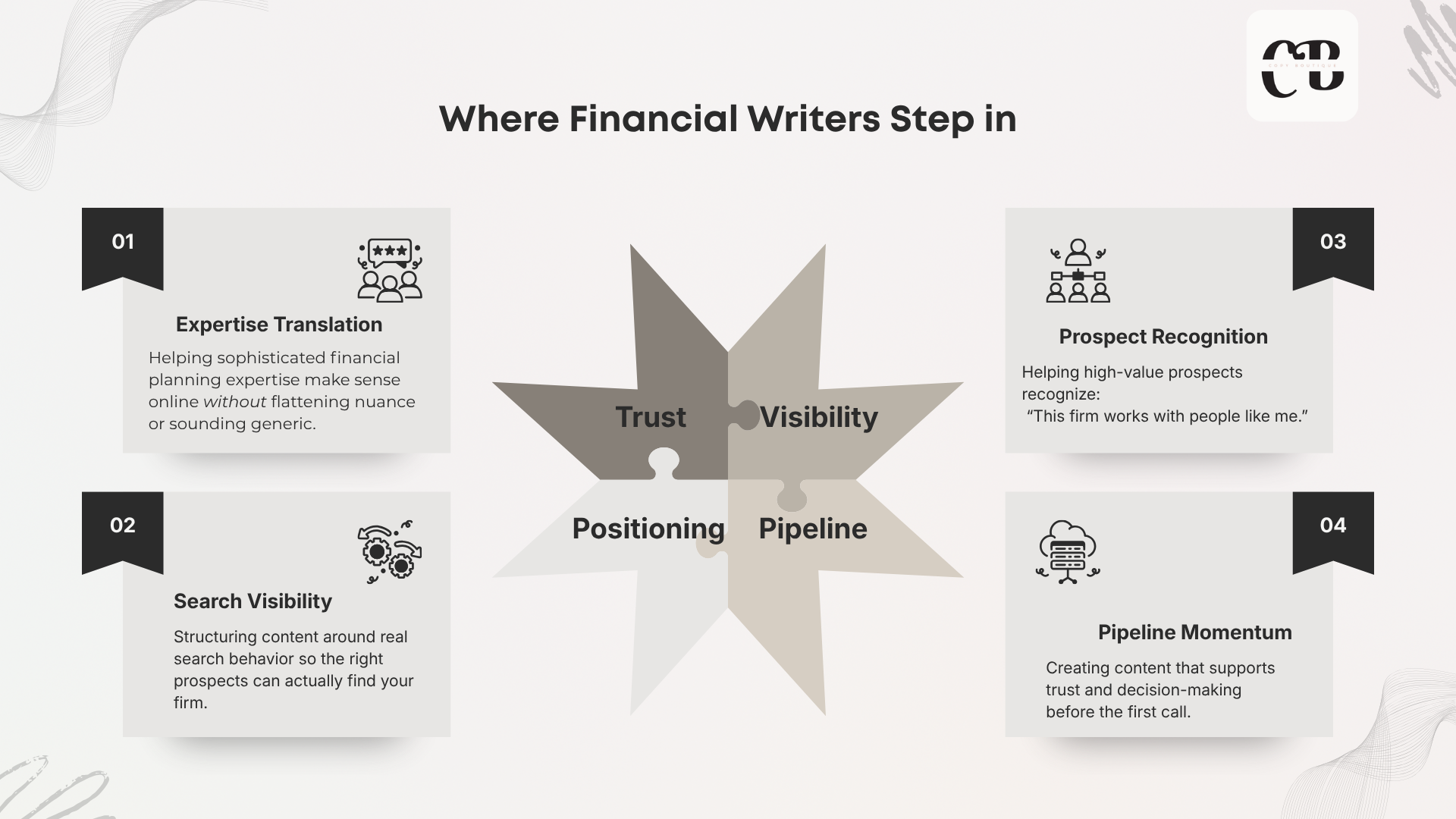
The surface-level brief — blogs, newsletters, website copy — isn’t usually what drives the decision to hire. Firms are paying for something way more specific than content; they're paying for what that content is supposed to do.
Prospects who are already a good fit
The right content helps the right people recognize themselves in what they're reading. A prospect dealing with a business sale, a concentrated stock position, or a complex executive compensation package should land on a firm's website and feel like the firm already understands their situation. That feeling of being understood is what turns traffic into inquiries worth taking.
It also works in the other direction. Content that speaks to a specific kind of client filters out the ones who aren't a good fit before they ever get on a calendar and take up your precious time.
Expertise that comes through online
A lot of firms are excellent in conversation but very difficult to read online. The thinking that makes them genuinely good at what they do doesn't make it onto the website. A financial writer's job is to make that thinking visible, so prospects can understand what the firm actually does and why it matters before the first meeting.
Discoverability
High-intent searches happen before most prospects reach out to anyone. Someone researching Roth conversions during a low-income year, planning around a business exit, or trying to understand their equity compensation isn't just browsing — they're looking for something specific.
Content that matches that intent, and that speaks to someone at that stage of thinking, is what turns search traffic into a real pipeline.
Momentum
Strong content has the power of compounding. A referral who looks up the firm afterward and finds writing that reinforces what they were told is more likely to follow through. A prospect who has read three articles before the first call arrives differently than one who found the firm five minutes ago. Over time, that momentum makes marketing less dependent on constant outbound effort and advisor explanation.
Why Financial Advisor SEO Usually Misses the Point
Most financial advisor SEO content that doesn’t do what it’s meant to fails for the same reason: it's written for search engines instead of the people actually searching.
The result is a library of articles that rank for broad terms and attract nobody worth talking to. "What Is a Roth IRA?" might bring in traffic. It won't bring in a 58-year-old business owner trying to figure out whether a Roth conversion makes sense in the two years before she sells her company.
The specificity of the topic tells the reader something. It tells her the firm understands where she is, not just the general concept she could have looked up anywhere.
This is where a lot of firms' content investments stop working. Generic educational content has its place, but it doesn't do the job of helping the right prospect recognize that this firm works with people in situations like theirs. That requires a different level of thinking about who the content is actually for, what they're trying to figure out, and where they are in the decision to get help.
Visibility without that relevance doesn't turn into a pipeline. It’s the strategy that ties it all together that does, and a financial writer is ideally someone who is willing to own that strategy.
The Real ROI of a Strong Financial Writer
The returns that matter from good financial writing don't show up in pageviews or follower counts in the way they show up in the quality of what comes through the pipeline:
Prospects who reference an article in the first meeting arrive differently from those who found the firm five minutes before the call.
Referrals who already understand what the firm does are easier to convert.
Inquiries that are specific about the kind of help they're looking for take less time to qualify.
With the right content strategy, the groundwork has already been laid, and the conversation can start somewhere more useful.
That's what strong financial copywriting actually works toward — shorter decision cycles, less friction in the sales process, and prospects who come to you with a level of trust that used to take multiple conversations to build.
For most firms, the compounding effect is what really makes it valuable over time. Content that continues to work, continues to attract, and continues to reinforce the firm's positioning long after it was written — without requiring an advisor to manually explain the firm's value every single time.

The Right Financial Writer Changes More Than the Words
For most firms, the expertise is not a problem; you probably don’t have to go learn more to bring in the clients you want. Your thinking is sophisticated, the planning is genuinely good, and the clients who work with you know it. The problem is that none of that is visible to someone who hasn't met you yet.
Strong financial writing is designed to close the distance between you and your dream clients. It takes the thinking that makes your firm worth hiring and puts it somewhere a prospect can find it, read it, and use it to make a decision — before anyone has picked up the phone.
Over time, that content becomes one of your firm's most durable assets: working continuously, attracting the right people, and making every subsequent conversation easier than the one before it.
The firms that figure this out know to stop treating content as a task to check off and start treating it as a major part of their client pipeline. That stage is usually where marketing starts to feel like it's actually working.
If your firm's expertise isn't coming through online — or your pipeline still depends more on referrals and personal explanation than you'd like — I can help you figure out where the disconnect is and what to do about it.
I work with financial advisory firms on content strategy, website copy, SEO articles, and newsletters, with a focus on attracting the right clients and making the firm's thinking visible to the people most likely to become them.
Contact me to talk about what that could look like for your firm.
