
How a Financial Copywriter Supports RIA Lead Generation
Who is that one client who made you think: I wish we could meet more people like this?
Maybe that’s the business owner who understood the value of your planning work immediately, or the executive with a complex financial planning picture and a clear need for advice, or maybe a retiree who had been searching for guidance that can help them enjoy the life they spent their life working towards.
The client that lights you up, who you’re excited to get on calls with.
The frustrating part is that your firm isn’t having problems serving those clients, but the challenge is in attracting more of them, consistently.
That’s where so many RIA lead generation strategies can feel like they’re not doing much. You may have some leads or eyeballs on your firm, but if they’re not the right clients, or not coming in consistently, it doesn’t do much.
More activity only works when the right people can quickly understand why your firm is exactly what they’re looking for. That’s where creating a strategy with a financial copywriter plays a bigger role in your RIA lead generation than many firms even realize.
Your dream clients are out there, but you need the right strategy to generate more of them and bring them in as clients.
What Is RIA Lead Generation?
Keeping it to the basics, RIA lead generation is the process of attracting potential clients to your firm and creating opportunities for them to become clients. That can happen through a variety of different channels, including:
Referrals
Search engines
Social media
Email marketing
Educational events
Strategic partnerships
Most firms already have some version of lead generation happening. A prospect may find out about your firm through a referral, find one of your articles on Google, come across a LinkedIn post, or download a guide from your website. From there, they start gathering information about you.
They visit your website, and they read a few articles. They skim your About page. They subscribe to emails.
Then, they compare your firm to their other options.
Every one of those steps influences whether they continue moving forward or move on.
That's why lead generation is about so much more than attracting attention. The experience prospects have after they find your firm plays a major role in whether they ever become a lead in the first place.
Where Your Prospects Form Opinions About Your Firm
It’d be rare for a prospect to discover an RIA and schedule a call the same day. More often, what really happens is they piece together their understanding of the firm over time.
They might find an article through Google. A few days later, they’ll visit the website. Maybe they read the About page, browse a service page, download a resource, or subscribe to emails. Weeks later, they come across a LinkedIn post and decide to take another look.
Each of those interactions adds another piece to the picture they're building.
By the time a prospect reaches out, they've usually developed their own assumptions about who the firm serves, what it specializes in, how it approaches planning, and whether it feels like a potential fit.
Those impressions don't come from any single source. They're all determined by the website copy, the emails in their inbox, the language on a landing page, the articles they read, and every other written touchpoint they encounter along the way.
A prospect's experience with your firm is largely built through words long before they ever speak to an advisor. That's one of the biggest reasons financial copywriting plays such an important role in RIA lead generation.
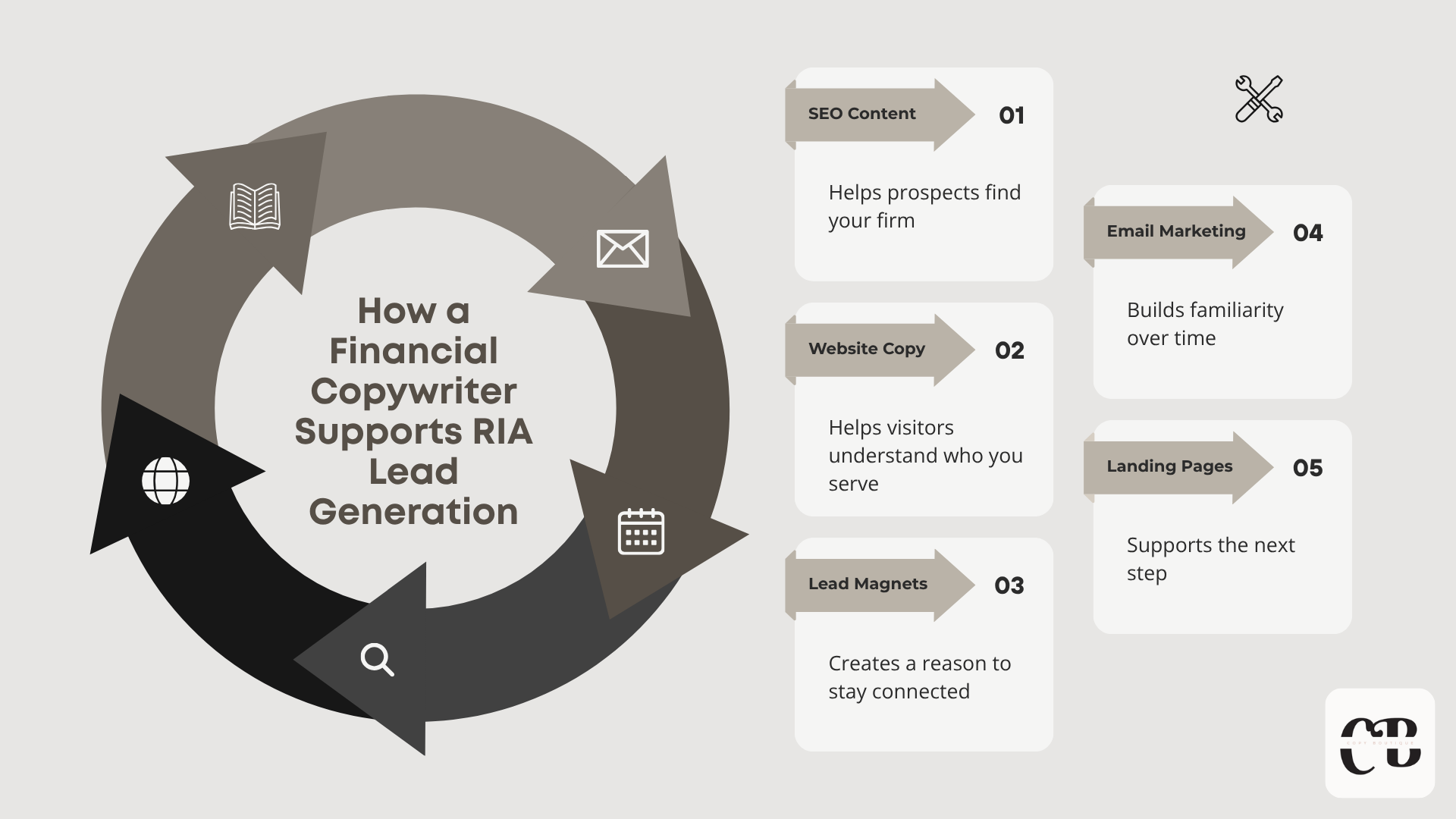
How a Financial Copywriter Supports RIA Lead Generation
When people hear the term financial copywriter, they often think of the person writing your blogs or emails. And blogs can absolutely support lead generation, but they’re only one piece of a much bigger picture.
Prospects don't decide to contact a firm because of a single article. Even if it’s the best article in the entire world, like this one (jokes). Their decision is shaped by dozens of micro-interactions over time.
The right financial copywriter helps ensure those touchpoints are working together in a cohesive strategy toward the same goal: helping the right prospects move from being interested to being ready.
Website Copy
For most prospects, the website is the first meaningful interaction with the firm. Within a few minutes, they're trying to answer questions in their head like:
Who does this firm work with?
What kinds of problems do they solve?
Am I the type of client they're built to help?
The right website copy helps visitors find those answers quickly and gives them a reason to continue learning more.
SEO Content
Many prospect relationships actually begin with a search. Even more now that we have AI tools at our disposal.
A business owner researching succession planning, or an executive navigating equity compensation, or a retiree thinking about their Roth conversion opportunities: SEO content helps firms show up when those searches happen.
A financial copywriter helps turn advisor expertise into content that answers those questions in a way that attracts actual clients into your sphere.
Lead Magnets
Not every prospect is ready to schedule a call immediately. Or even a few weeks from now.
Guides, checklists, ebooks, and other downloadable resources create an opportunity to continue the relationship after the initial visit.
They also provide additional value while giving prospects a reason to stay connected. In exchange for the valuable resource you give them, they usually give their email address, which allows you to market to a list that you already know is interested in what you have to offer.
Email Marketing
Most massive financial decisions aren’t made overnight; email helps firms stay visible and build relationships during the weeks and months between a prospect's first interaction and their eventual decision to reach out.
An effective email strategy can reinforce expertise, build familiarity, and keep the firm top of mind when the timing is right.
Landing Pages
Every marketing effort eventually asks a prospect to take some kind of action.
Schedule a call. Download a resource. Register for an event.
Landing pages that host those things help support those decisions by providing the information prospects need to feel comfortable taking the next step. You can get someone to check out the page, but if there’s nothing on there that makes the action feel compelling, then you’ve lost that traction.
These assets may look like separate deliverables, but firms are usually investing in something bigger: stronger positioning, a better prospect experience, and marketing that supports growth over time. I break that down more in “Why Financial Advisors Hire Financial Writers”.
How Financial Copywriting Actually Impacts Lead Quality
Not every inquiry has the same value to a firm. Most advisors would rather have a handful of conversations with ideal prospects than dozens of conversations with people who were never going to be a fit.
That's the whole reason lead quality matters so much.
You don’t want a million calls on your calendar with the hopes that a few will become clients once you’ve exhausted your time and energy meeting everyone and their grandmother. You want more conversations with the prospects who have the complexity, urgency, and assets to become long-term clients.
That’s why the copy your firm publishes is so integral to everything that comes next. The words prospects see before reaching out affect what they believe the firm does, who it serves best, and whether their situation belongs there.
Over time, those touchpoints help prospects answer: "Is this firm built for someone like me?"
Your firm needs more than “good writing” to answer that question.
The financial copywriting that’s going to help you reach your goals is engineered to help the right prospects recognize themselves in what they're seeing and give them confidence to reach out.

When It All Works Together
A few years ago, I started working with a firm that wanted to attract more business owners. The firm had the expertise with this demo, but there wasn’t a clear path for those prospects to find them, learn from them, stay connected, and eventually reach out.
So we built around one specific client situation and created a set of assets that worked together:
Educational content around the questions business owners were already researching
A downloadable resource that gave interested prospects a reason to stay connected
Email follow-up that continued the conversation over time
Copy that connected the firm’s specialty back to the client’s actual decision
That work continued to compound long after it was published. 2 years later, prospects are still finding the content, downloading the resource, joining the email list, and reaching out to the firm citing what they read.
That’s where financial copywriting becomes a huge lever for lead generation: the right words create assets that keep attracting and nurturing the right prospects over time.
FAQs About RIA Lead Generation
What Does a Financial Copywriter Do?
A financial copywriter creates the marketing and client-facing content for financial firms.
This can include things like website copy, emails, lead magnets, landing pages, blogs, and other marketing assets designed to attract prospects, build trust, and support business growth. Unlike a general copywriter, a financial copywriter understands financial concepts, industry regulations, and how prospective clients look for financial advice.
How Does a Financial Copywriter Help With Lead Generation?
A financial copywriter helps firms attract, educate, and convert prospective clients through creating strategic marketing assets. Website copy, SEO content, lead magnets, email campaigns, and landing pages can all support lead generation by helping prospects understand the firm's expertise and feel confident taking the next step.
Does Content Marketing Generate Leads for RIAs?
Yes! Content marketing can support RIA lead generation by helping prospective clients find the firm through search engines, social media, referrals, and email marketing. Educational content also gives prospects an opportunity to learn about the firm's expertise before scheduling a conversation.
Is SEO Important for RIA Lead Generation?
SEO can be a really effective source of lead generation because it helps financial firms appear when prospective clients are actively searching for answers. Topics like retirement planning, Roth conversions, business succession planning, and executive compensation can create opportunities for the right prospects to discover the firm online.
What Type of Content Attracts Financial Planning Clients?
The most effective content is often tied to real client situations and decisions. Articles, guides, emails, and other resources that address specific challenges—such as retirement transitions, concentrated stock positions, business exits, or tax planning opportunities—tend to resonate more strongly than broad financial education alone.
Final Thoughts
Every RIA has a version of that ideal client:
The business owner who immediately understands the value of your planning
The retiree who has been looking for the exact kind of guidance you offer
The prospect who comes to the first call ready for a meaningful conversation, instead of needing to be convinced one should happen
Attracting more of those people isn’t going to come down to a single blog post, email, or website update. It ultimately comes from creating an experience that helps the right prospects find your firm, understand your expertise, and feel confident taking the next step.
That is where financial copywriting can play a huge role in RIA lead generation. The words prospects encounter before they ever speak to an advisor can really shape how they perceive the firm, whether they see themselves in the clients you serve, and whether they decide the conversation is worth having.
If you're interested in learning more about how website copy, SEO content, email marketing, and other marketing assets can support your firm's growth, check out the rest of the blog for additional tips and strategies designed specifically for financial advisors and RIAs.
