
The RIA Marketer's Guide to Compliant Content: What You Can Say, What to Avoid, and How to Publish With Confidence
I’ve seen this inside almost every RIA I've worked with.
Someone on the team — usually the marketing manager, sometimes a principal — comes up with a genuinely good content idea. It's specific, it's timely, it speaks directly to the kind of client the firm wants more of.
And then it goes into review, and what comes back is a version so softened and hedged that it barely resembles the original. Or it doesn't come back at all…
After enough rounds of that, the team loses its excitement for generating ideas. They still have them, but they've learned that the path from idea to published is too painful to even bother.
And while it seems like compliance is the problem, it’s really a process problem that compliance is taking the blame for.
I'm a marketing consultant, not a compliance attorney, and I'll say that very clearly. Nothing in this article is legal advice, and your compliance officer or a qualified attorney should always have the final word on what's right for your specific firm.
What I can share is the working knowledge I've built writing and strategizing content for RIA firms: what the rules actually say, what they're most commonly misread to mean, and what a functional content workflow looks like when it's built with compliance in mind from the start.
Because the firms I've seen publish confidently and consistently aren't doing it by ignoring compliance. They're doing it because they built a system that makes compliance review fast and predictable instead of a recurring source of friction.

Why the Fear Around Compliance Is Costing RIAs
Most RIA marketing conversations about compliance are framed around risk: what could go wrong if you say the wrong thing. That framing, while valid, is incomplete.
There's another risk sitting on the other side of it: the business risk of staying silent while firms with less expertise and maybe even looser standards publish freely and take up space in your market.
Your ideal clients are searching for answers right now. They're reading content (yes, even in 2026), forming impressions, and deciding which firms seem like they actually understand people in their situation. If your content isn't there, another firm's is. And that firm doesn't have to be better than you; it just has to show up.
Compliance anxiety — the kind that paralyzes content before it's ever published — is not the safe choice. It's opting for a different kind of risk, one that just doesn't show up in an audit.
What the Rules Actually Say
The SEC's updated Marketing Rule, which took effect in November 2022, replaced two older rules and modernized the framework for how investment advisers can advertise and market their services. For RIAs, this is the governing framework for most of what you'd call content marketing.
Here's what it prohibits:
What's clearly off the table
Specific performance claims without the required context and disclosures
Presenting hypothetical performance in ways that don't meet the rule's requirements
Testimonials or endorsements that don't include required disclosures
Cherry-picked results that create a misleading impression of your track record
Statements that are untrue or omit material facts in ways that mislead
What's clearly fine, and wildly underused
Educational content explaining financial concepts, planning strategies, or market dynamics
Market commentary and thought leadership that shares perspective without making guarantees
Content about your firm's investment philosophy and how you approach decisions
Explanations of how different client situations are handled
Content about who you serve and why that matters
You can have opinions. You can explain how you think. You can write about the specific situations your best clients come in with and how your firm approaches them. None of that requires a disclaimer longer than the article itself.
The regulation is tightest around performance. Everything else is much more open than compliance anxiety suggests.
The grey zone
Third-party ratings, client reviews, and social proof are now permissible under the updated Marketing Rule, but with disclosure requirements that vary depending on how they're used. If your firm is considering testimonials or ratings, this is exactly the kind of area where your compliance officer's guidance matters.
The rule opened the door here; it didn't leave it unattended.
The Content Types That Work, and How to Execute Them Without Stepping on Landmines
Educational blog articles
Educational blogs are the safest content type in the RIA space. An article that explains how Roth conversions work, what questions to ask before consolidating accounts, or how to think about sequence-of-returns risk in the years before retirement — none of that is giving personalized advice.
It's education. And education is what your prospects are actively searching for before they ever consider reaching out.
What keeps educational content clean: inform, don't prescribe. Explaining how something works is different from telling a specific person what to do. Your compliance officer knows this. Most firm guidelines just haven't had it spelled out clearly enough to write with confidence.
Thought leadership and market commentary
This one gets avoided more than it should. Sharing your perspective on what's happening in markets, on planning strategies that are getting more relevant, on what you think the next few years look like for a particular type of client, all of that's opinion. Opinion isn't a performance claim. It's literally just your voice.
The framing that keeps thought leadership compliant is the same framing that makes it worth reading: “this is how we see it,” not “this is what will happen.”
The difference between a prediction and a perspective is incredibly important to regulators, and it's also what separates thought leadership that builds trust from the kind that can erode it.
Email newsletters
The main compliance consideration for email is recordkeeping. Under SEC rules, your firm's electronic communications — including marketing emails — need to be archived. Most modern email platforms make this manageable, but if you're not sure whether your firm's current setup satisfies that requirement, that's a question for compliance before you build a content cadence around email.
The content rules for email are essentially the same as for everything else. The archiving requirement is where firms can sometimes get caught off guard.
Social media
FINRA and the SEC distinguish between "static" content — posts that don't change after they're published — and "interactive" content like comments and responses. Static posts are generally treated like other advertising, subject to review and recordkeeping.
Interactive content, on the other hand, adds a layer of complexity that's worth having a clear firm policy on before you build a social presence.
For most RIAs, LinkedIn is the primary platform and the one with the clearest path to compliant use. A consistent publishing cadence of original thought leadership, with a defined review workflow and an archiving solution, is well within reach.
Client testimonials and reviews
The 2022 Marketing Rule update changed this significantly. Testimonials from clients are now permissible for investment advisers — a big jump from the prior rules — but they come with specific disclosure requirements: you need to disclose if the person was compensated, whether they're a current client, and any material conflicts of interest.
If your firm is considering adding testimonials or reviews to your marketing, do it with compliance at the forefront from the beginning. The new rule created opportunity; it also created requirements that are easy to miss.
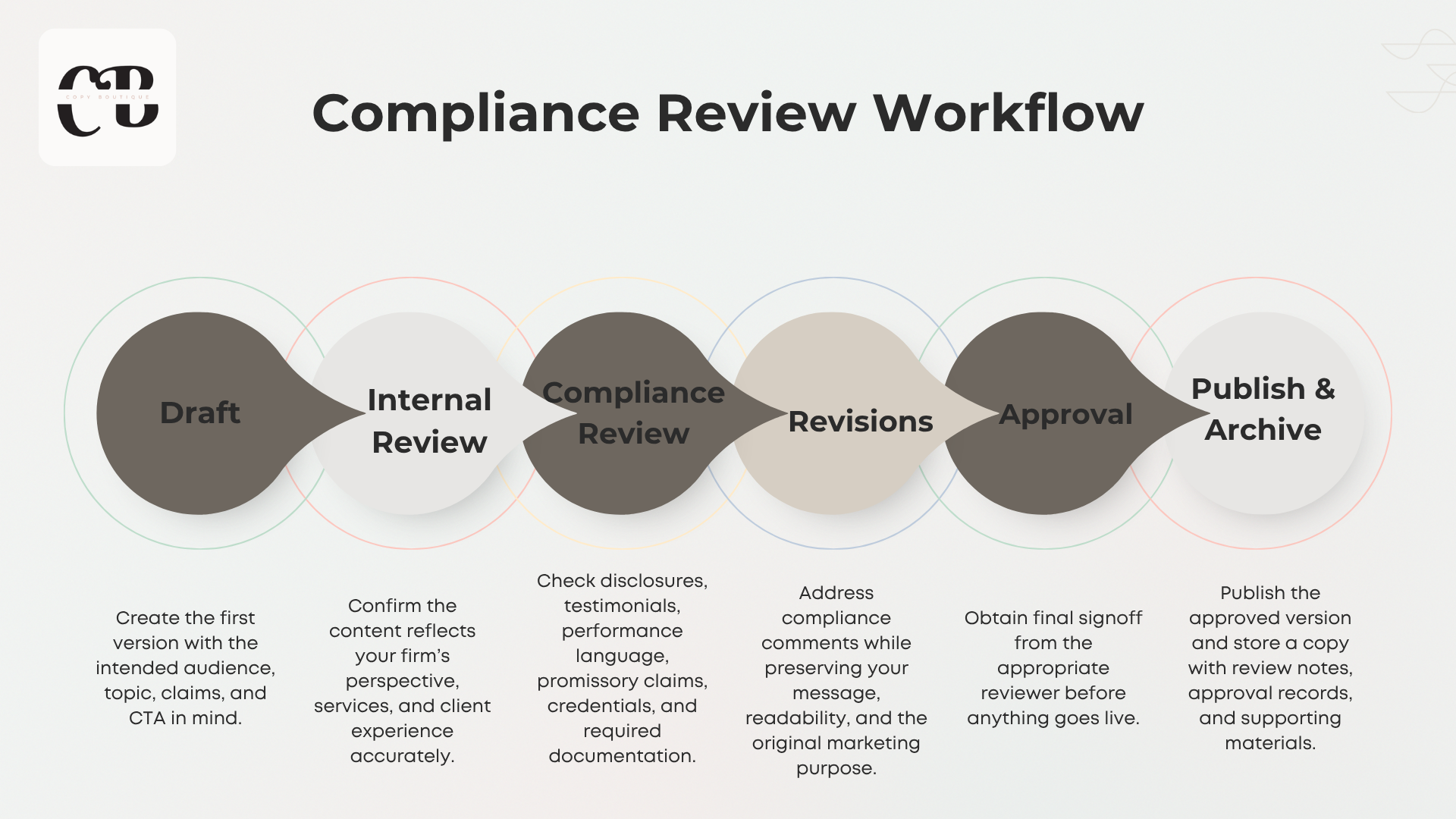
The Workflow That Makes All of This Manageable for Your Firm
The firms that publish consistently are doing it because they’ve built a review process that has clear lanes, predictable turnaround, and content that arrives at review already written to pass.
That last part is the piece most firms can miss. If content goes to compliance review with performance claims buried in the second paragraph, or with language that implies guarantees without meaning to, the back-and-forth is inevitable.
If content arrives written with the framework already in mind — educational, perspective-based, free of the specific language patterns that trigger revision — review moves faster.
The workflow I use with RIA clients has three stages:
Draft with guardrails built in
That means no performance claims, no guarantees, clear framing of opinion as opinion, and consistent use of language like "may," "can," and "for some clients" rather than "will" and "always." It also means keeping the focus on situations and thinking rather than on outcomes and results.
Structured internal review
Not "send to compliance and wait," but a clear checklist that makes the review consistent and the turnaround predictable. When compliance review follows a documented process, it becomes routine.
Archive and publish
With records maintained in whatever system your firm uses, so that if a question ever comes up, the documentation exists.
This isn't complicated. It just requires that someone builds it, and that the content arriving at review is written by someone who understands the framework well enough to stay inside it.
The Cost of Making Compliance the Reason You Don't Market
Let’s say the compliance concern wins and nothing gets published.
The right prospects land on your site, see content that's been so thoroughly reviewed it no longer sounds like a human being wrote it, and leave without a strong impression. Or they don't land there at all, because there's nothing being published that search engines can surface or people can share.
The better-fit client you'd have a strong first call with finds a competitor's article first, recognizes themselves in it, and reaches out to that firm instead.
There's no obvious failure in that story, and no compliance violation. Just the steady, invisible cost of content that didn't get made, or that got made but lost everything that made it worth reading by the time it was approved.
The firms that are building real inbound pipelines right now are publishing consistently, writing in a recognizable human voice, and working within the compliance framework rather than around or against it. That combination is rarer than it should be, even today. Which means it's still a real differentiator for the firms willing to actually do it.
If Your Marketing Strategy Is Sitting on a Whiteboard Somewhere
Let’s be honest. The compliance framework isn't the thing standing between your firm and a content strategy that actually works.
Most of the content worth publishing for an RIA firm — the educational articles, the market perspective, the thought leadership that makes prospects feel like you already understand their situation — is well within what the rules permit.
What's standing in the way is usually a process that doesn't exist yet, and content that wasn't written with the framework in mind from the start.
That's the area I work in. I write and strategize content for RIA firms that need to be both genuinely good and genuinely compliant; content built to move through review cleanly and to create real results once it's out in the world.
If your firm has the strategy and the expertise, but the content isn't getting made consistently, let's talk.
This article reflects my working knowledge as a marketing consultant to RIA firms and is not legal or compliance advice. Always consult your compliance officer or a qualified attorney for guidance specific to your firm.
FAQs
Do RIAs need to archive every piece of content they publish?
Yes, generally. Under SEC recordkeeping rules, investment advisers are required to retain copies of advertisements and certain communications, including written content published as part of their marketing.
The specific requirements depend on your registration status and what the content contains. Most modern email and social media platforms have compliance archiving integrations — check with your compliance officer to confirm your current setup satisfies the requirement.
Can a financial advisor ask clients for Google reviews?
Under the updated Marketing Rule, yes — with disclosures. Client testimonials and reviews are now permissible for investment advisers, which is a significant change from prior rules. But using them in your marketing requires disclosing whether the client was compensated, whether they're a current or former client, and any material conflicts of interest. Getting this right means working with compliance before you publish.
What's the difference between advertising and educational content for SEC purposes?
Educational content explains how financial concepts, strategies, or situations work without directing a specific person to take a specific action. Advertising promotes your firm's services and is subject to the Marketing Rule's requirements.
In practice, a well-written educational article that doesn't mention performance, doesn't make personalized recommendations, and doesn't make implied guarantees sits perfectly on the educational side of that line.
How often should an RIA's content go through compliance review?
Every piece of external marketing content should go through your defined review process before it's published. The goal to build toward is a faster, more consistent review. That happens when the workflow is documented and when the content arrives at review already written within the compliance framework.
Does an outsourced content writer need to understand compliance?
Yes — and this is probably the most important thing you can look for when considering outside marketing support.
A writer who doesn't know the difference between a performance claim and educational commentary, or who doesn't understand the Marketing Rule's disclosure requirements, is going to generate compliance friction on every piece. That friction teaches your compliance team to distrust the content before they've read it. The right outside partner should make your compliance review easier, not harder.
