
Financial Copywriting: Why Good Writing Isn’t Enough in Financial Marketing
TL;DR
Clear writing is important, but it rarely changes pipeline outcomes on its own. In financial marketing, what drives results is how clearly a firm’s thinking is communicated, how well it is built around real client situations, and whether it influences decisions before the first conversation.
Good Writing Isn’t the Problem
There is no shortage of amazing writers out there. It’s not hard, especially in the age of AI, to get content that’s clear and (hopefully!) accurate. Firms can hire a writer to have professional-sounding content that looks completely fine on its own.
But when you zoom out and look at what’s happening (or not happening) around it, a very different picture shows up.
The pipeline doesn’t reflect the level of work the firm is capable of
Conversations still start at the beginning, with the same explanations repeated over and over
Decisions take longer than they should.
So, it looks like the issue isn’t how well it’s written. Rather, it’s that the writing isn’t changing anything.
What “Good Writing” Actually Does (and Doesn’t Do)
“Good” writing does exactly what it’s supposed to do.
It makes ideas clear. It explains concepts in a way that’s easy to follow. It removes friction for the reader.
And while all of that is valuable, it’s also where it stops.
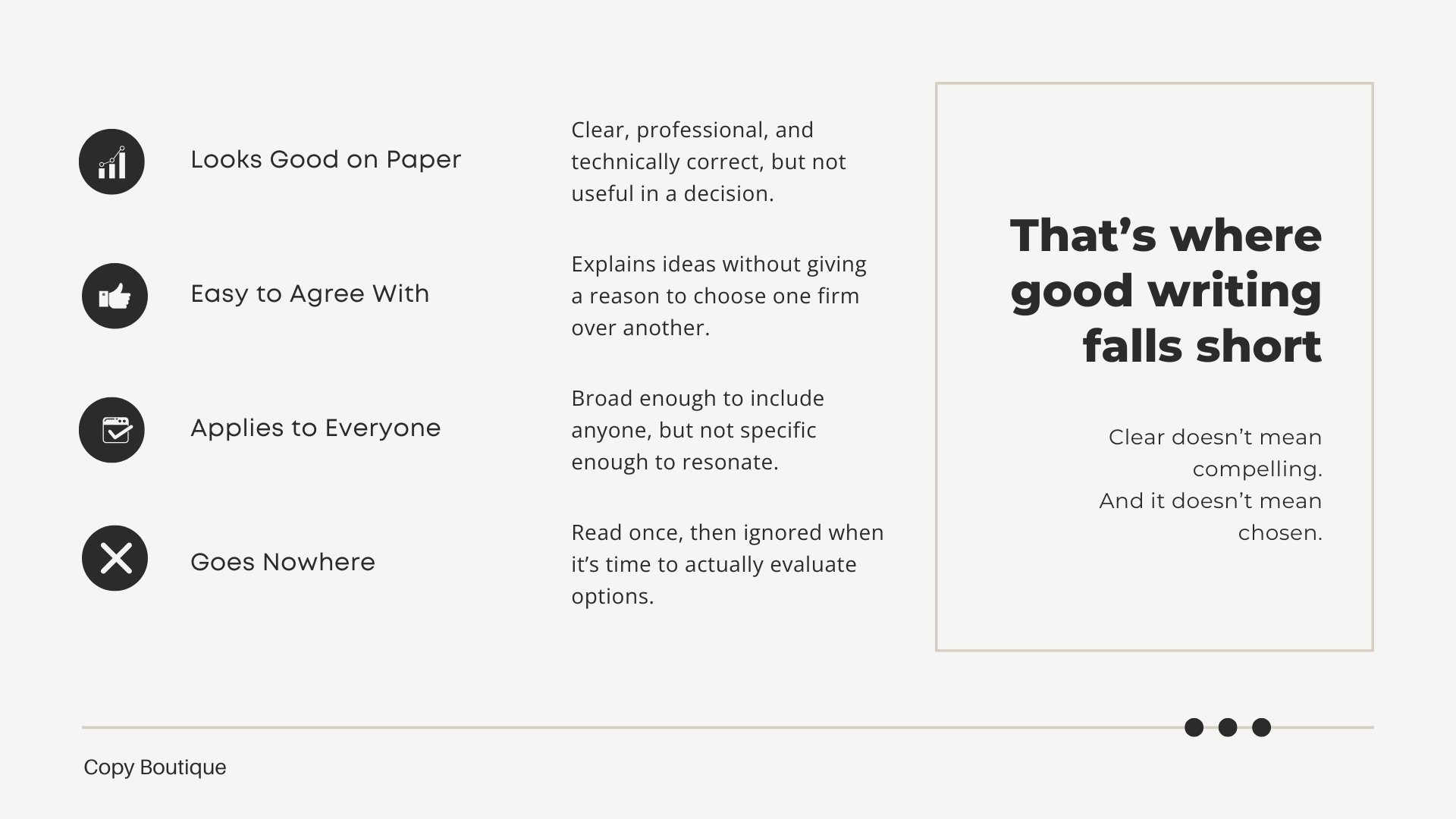
Technically correct writing doesn’t give a prospect a reason to choose one firm over another. It doesn’t show how you approach decisions or what makes your thinking different. And it doesn’t move someone any closer to deciding whether you’re the right fit and taking the next step.
It makes the content easier to read; it doesn’t make the firm easier to choose.
Why Even the Best Writing Doesn’t Mean Good Marketing
When it comes to content or copy that will create results for your firm, the qualification isn’t that content exists somewhere. It has to carry through to the things that matter.
Your content has to clearly connect to your pipeline. Your audience has to see themselves in it. They have to walk away with a confident understanding of how the firm’s work applies to their exact situation. When they reach out, they shouldn’t need basic explanations to fill the first meeting.
If advisors are explaining the same things over and over, decisions are taking longer, or outcomes feel inconsistent, good writing isn’t what’s going to move the needle — that’s the job of high-quality strategy behind the words.
What Prospects Are Trying to Figure Out Before They Reach Out
Before someone books a call, they’re not looking for more information, even if that’s what they’re asking for. They’re really trying to make a judgment:
Does this firm understand situations like mine?
How do they approach decisions?
Is this worth spending time on a conversation?
That’s where they filter. They’re not reading your content to learn in a general sense. The audience that’s likely to be your next client is using it to decide whether you belong on their shortlist.
And if they can’t answer those questions quickly, they move on. There’s no shortage of options for them.
At the stage where they’re deciding on a firm, they’re not looking for something that’s well-written; they’re looking for confidence to reach out.
What Changes When Content Does More Than Read Well
When content does more than just read well, it changes how much work your team has to do to get to a decision.
Prospects who are looking to become clients don’t show up trying to understand the basics. They more often come in with that context. They’ve already formed an initial view of how the firm thinks and whether it applies to them.
When content does its job:
Instead of 3-4 conversations to reach a decision, it’s 1-2.
Instead of re-explaining the same process every time, that work is already done.
Instead of broad, exploratory calls, conversations are focused and specific.
All of this has a measurable impact on the pipeline:
Fewer calls required per close
Less time spent per prospect
Shorter timelines from first conversation to decision
Higher percentage of right-fit inquiries
And all of that compounds.
If your team is having 10-15 prospect conversations a month, even reducing one call per decision frees up hours of advisor time and shifts more of that time toward conversations that actually move forward.
The early-stage work — understanding, context, initial fit— is already handled before the call. The conversation doesn’t have to build from zero. It starts further along.

From Writing to Decision Support
Most firms think they need better writing. They don’t.
They need content that actually does something.
Right now, most content is treated as output: blog posts, emails, website pages. Things to publish, maintain, and check off.
That’s not what changes outcomes. The real difference comes from treating content as something that supports a decision, not just something that gets published.
That means it’s built to do a specific job:
Reflect the kinds of situations your best clients are actually navigating
Make your thinking visible, not just your services
Signal clearly who the firm is (and isn’t) for
Show up when a prospect is actively evaluating their options
When content is structured this way, it becomes part of how someone decides whether to work with you.
Writing Isn’t What Does It
At some point, it’s worth asking: Why isn’t any of this changing anything?
Your content is there, it’s consistent, and it reads well. And yet, nothing downstream feels different.
Calls still start from the beginning, like they always have. Decisions still take longer than they should. Your pipeline doesn’t reflect the level of work you actually do.
That’s the sign that something needs to change, because the issue isn’t the quality of the writing. The problem is that it’s not doing anything before the conversation starts.
Most firms already have good writing, whether internally, through tools, or through a content writer. Much fewer have content that changes how a prospect evaluates them.
If your content isn’t shaping how someone understands the value of your firm, what you do, how you think, and whether you’re a fit, better writing won’t fix it.
What will is rethinking how your content actually functions.
If you want to see what that would look like inside your firm — where your content is falling short, what prospects are actually picking up (or missing), and how to turn it into something that influences decisions before the call — you can book a call here.
