
Financial Advisor Content Strategy: Building Content That Keeps Working
A lot of financial firms create content the same way they answer emails: whatever feels most urgent is what gets handled first.
This month, someone needs a blog, and next month, the market update takes priority. Then an advisor has an idea for a newsletter, marketing wants a lead magnet, and a service page needs to be rewritten before a campaign launches.
Each request gets finished as it comes and the content calendar keeps moving. Yet the firm ends up with a growing collection of marketing assets that have very little to do with one another.
That makes content marketing for financial advisors so much harder than it needs to be. Every new project takes another round of brainstorming, research, writing, review, and compliance, while much of the work created before it is sitting there, untouched in the archive.
It also limits what the content can accomplish through search. SEO for financial advisors is much stronger when related articles answer the next questions, link to useful resources, and give search engines a fuller picture of the firm’s expertise, while a scattered publishing schedule makes that harder to build.
A strategic financial advisor content strategy treats every article, email, guide, and webpage as part of a growing library. Each piece answers a useful question on its own while creating somewhere for the reader to go next. Over time, this means your firm has a body of work that keeps giving prospects new ways to find, understand, and return to the firm.
Why Content Marketing and SEO Shouldn’t Be Separate Conversations
SEO needs something useful to rank. So many people miss this part.
A list of target keywords can show you what people are searching for, but it can’t answer those searches on its own. Your website needs articles, service pages, FAQs, guides, and other resources that give search engines a reason to show your firm as a result.
This is where content marketing for financial advisors and SEO for financial advisors start feeding each other over time.
SEO research can show you the questions people ask before they choose an advisor, and your content gives your firm a place to answer them. Each new piece then creates another possible entry point through Google or AI, while internal links help readers move from the original question toward related resources and services.
Take a topic like retiring with company stock.
Maybe one article focuses on concentrated positions, and then related pieces could cover: net unrealized appreciation, tax planning before retirement, charitable giving, withdrawal decisions, or what happens to stock options after leaving an employer. Together, those articles give search engines a better picture of your firm’s expertise and give the reader several useful paths to follow.
The same content can support the firm outside search. An advisor can share it with a prospect after a call, include it in a newsletter, reference it in a LinkedIn post, or send it to a client who asked a similar question. Someone who first finds the article through Google can also use it to get a feel for how the firm approaches the issue.
A shared plan keeps the keyword research, publishing calendar, internal links, service pages, and calls to action all working toward the same result. Each article earns its place by answering a real question and strengthening the resources around it.
Give Every Article Somewhere to Connect
A lot of financial firms publish around whatever’s due next, whether that’s a market update or a new campaign. Once the piece is live, we just move on to the next request.
A much better plan gives each article a place within the website. A Roth conversion article might connect to related content on tax brackets, Medicare premiums, required minimum distributions, and retirement income while also supporting the relevant service page.
Those connections give readers somewhere useful to go next and help search engines understand the topics the firm covers. Over time, each article adds depth to the site instead of sitting alone in the archive.
Start With the Questions Your Team Hears Every Week
Your best topics may already be sitting in discovery call notes, review meeting agendas, email threads, and the FAQ document nobody’s opened in months.
As advisors, your firm probably hears the same concerns in different forms:
Can I retire after a layoff?
Should I convert part of my IRA?
What happens to Medicare premiums if my income spikes?
Each answer opens the door to another question, so a Roth conversion discussion can lead to tax brackets, required minimum distributions, Medicare premiums, charitable giving, and withdrawal sequencing. That gives your firm a connected group of topics drawn from actual client conversations.
Keep a shared list of questions from calls and emails, then group them by service area and stage of the client decision. You’ll have a publishing plan grounded in the issues prospects and clients already bring to the firm.
Every Article Should Have a Job
Before an article lands on the calendar, decide what it needs to accomplish. It might target a search term, answer a question advisors hear every week, support a service page, or introduce a guide someone can download.
The same piece can keep working after publication. A retirement tax article can link to related posts, lead the next newsletter, supply several LinkedIn posts, and direct readers toward another useful resource.
Defining the job upfront shapes the keyword, internal links, call to action, and promotion plan. The article enters the website with a purpose and defined connections to the rest of the firm’s content.
Content Should Become More Valuable Over Time
When done well, a content library only gets more useful as it grows. Each new article can link back to earlier pieces, answer a related question, and give readers another path through the website. Over time, your firm begins covering key topics from several angles instead of relying on a few scattered posts to do the job.
Older content can keep contributing, too. For some reason, we have this belief that older content isn’t doing anything for you anymore. Your content gets posted, gets buzz, and then that’s that.
Think about it: a tax-planning article may need updates when thresholds or rules change, while a retirement article can be expanded with new examples, FAQs, or links to a recently published service page. Those updates preserve the value of work the firm has already paid for and continue to support how Google and AI see your brand.
The same article can also inform an email, several LinkedIn posts, talking points for a webinar, or a follow-up resource after a client meeting. That reduces the pressure to invent something new every week and gives the firm more ways to use its existing expertise.
As those pieces connect and improve, search engines gain a fuller picture of the subjects the firm covers. The website becomes easier to explore, the content supports a wider range of searches, and each new article has a stronger base to build from.
What This Looks Like in Practice
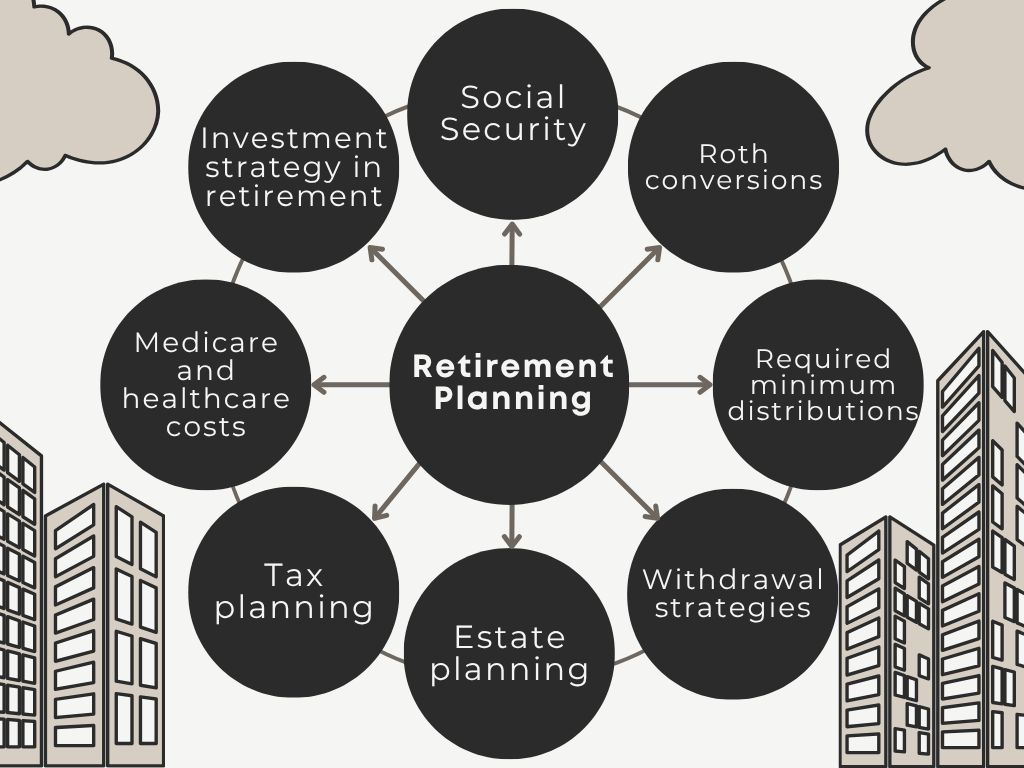
Say your firm wants to build content around retirement planning. The topic can branch into a series that follows the decisions clients and prospects are already considering:
Retirement planning → Social Security → Roth conversions → required minimum distributions → tax planning → withdrawal strategies → estate planning
Each article can answer a specific question while linking to the others. A Roth conversion article may lead into future RMDs and Medicare premiums. A withdrawal strategy article can connect income needs with taxes and Social Security timing. Estate planning then fits naturally once the discussion reaches beneficiaries, account ownership, and legacy goals.
Your firm gains several ways to appear in search, and readers can move through the topics that fit their situation. Advisors also have a larger set of resources to share in emails, meetings, and follow-up conversations. Beautiful.
Final Thoughts
A content plan grows one topic at a time. Each article answers a specific question, links to the resources around it, and gives the next piece somewhere useful to connect.
As that library grows, content marketing and SEO reinforce each other. Your firm has more opportunities to appear in search, more resources to share with prospects and clients, and more material to reuse across email, LinkedIn, and sales conversations.
I help financial firms plan and write connected content that supports search visibility and gives each article a longer life. Learn more about my SEO and content strategy services, or contact me to discuss what your firm could build next.
FAQ
What is content marketing for financial advisors?
Content marketing for financial advisors includes articles, emails, guides, videos, webinars, and social posts that answer questions prospects and clients already have. These resources help people understand the firm’s services, approach, and areas of expertise before scheduling a conversation.
Why is content marketing important for financial advisors?
Content gives prospects a way to evaluate the firm before reaching out. It also gives advisors reusable resources for common questions and creates additional ways for people to find the firm through search, email, LinkedIn, and referrals.
How does content marketing help SEO?
Search engines need useful pages that answer specific queries. Publishing related articles, linking them together, and updating older pieces gives the website broader topic coverage and increases its opportunities to appear in search results.
How often should financial advisors publish content?
The best schedule is one the firm can maintain while preserving quality. For many firms, one or two well-developed articles per month provides enough consistency to build a useful library over time.
What should financial advisors write about?
Start with the questions that come up during discovery calls, client meetings, review meetings, and email conversations. Topics should connect to the firm’s services and the financial decisions its clients regularly face.
How do topic clusters improve SEO?
A topic cluster connects a central resource with several related articles. Those internal links help search engines understand how the pages relate while giving readers an easy path to explore the subject in greater detail.
