
As a financial copywriter, I meet with a lot of firms. Something that I hear over and over again is that content is taking up too much time internally, but outsourcing feels like another project they’re expected to manage.
A lot of the time, that can be the case. Which is why I tell prospective clients to make sure they really understand the process before they decide to work with someone for support. Each professional is going to have their own way of working, so it’s important that you know what that looks like before you invest all of your time and energy into something that may require too much of you.
Over time, I’ve created and refined my processes when working with clients to make sure it gets them the results they’re looking for without pulling all of their time away for the tasks that they already cannot juggle internally. It’s not worth risking the time that should be spent taking care of clients.
If you’re a firm thinking about working with a financial copywriter or marketing consultant, here’s what that process can actually look like.
Before the Writing
You can’t take someone on a first date and expect to know everything about them. The same goes for our work together.
Before we even start working together, I typically get on an intro call with someone to learn more about them, their business, their clients, and their goals. This is where we really get to know each other, and I get to ask the questions that help me understand where they’re struggling and how/if our work together could best help them.
From there, I take all of that information and start my research so that I can give the best recommendation possible, whether that means working together or not. If it’s a match, I send them a proposal with either a custom strategy or a package that best fits their needs.
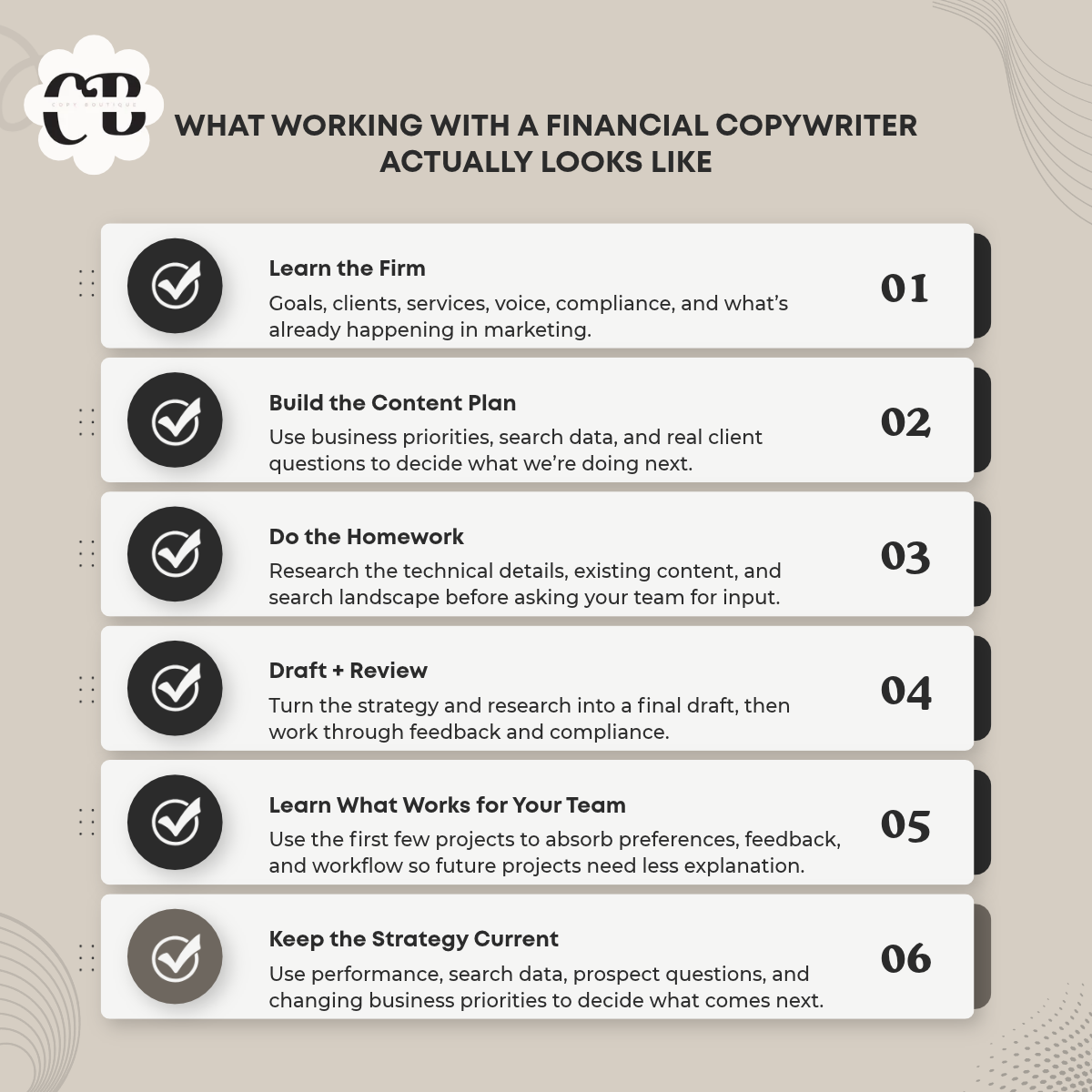
Then, it’s my turn to learn the business inside and out. That means the clients they want more of, the services they want to grow, existing content, voice/style/tone preferences, compliance guidelines, and search performance. I need enough context to make good decisions later without coming back to the client for background information every time we start something new.
My clients don’t have to explain their firm every single time there’s a new assignment. You shouldn’t have to either. This should feel like a big offload for your brain.
From Idea to Content Plan
Once we’re working together and I get to know my clients, we can start the fun stuff: strategy. Everybody’s dream.
As a financial copywriter, it’s my job to take my clients’ growth priorities, search data, advisor/client questions, competitive research, and existing content to decide what needs to be created.
This is the part where it can get very labor-intensive for firms when they look for a standalone writer.
A writer is typically different from a strategist. Some writing engagements are execution-only. In those cases, you may be expected to hand over a finished keyword, angle, brief, and outline that they can then turn into a finished product.
All of that’s fine if you have the internal capacity; a lot of my clients do not. This is another area where you want to have that expectation set ahead of time. You may feel like you need a standard writer when you really need more of a strategist/writer hybrid (I know one of those 😏).
The Research Before It’s On Your Plate
This is another part you want to understand before you take on more than you can chew: how much of the content is expected to come from you?
Now, you want your content or messaging to have strong elements of you. People want to feel like they’re getting to know someone from what they’re seeing on your website or social media. However, your writer should fill in everything they reasonably can before they start sending questions your way.
For a financial firm, the technical topic research, existing firm materials, prior content, current rules, etc., should all be the responsibility of your financial copywriter. If prior research can get an answer you can be confident in, you shouldn’t be expected to substitute for research.
In my business, I reach out to clients when it’s time to get their perspective. The ideas and POVs that only that client can give me. The information from the client calls I wasn’t there for. I do not reach out to my clients to ask what the most recent tax brackets are or how a Backdoor Roth works in general.
Your time is incredibly valuable. I am a firm believer that it should only go toward the pieces that can only come from you.
When It’s Time to Draft and Review
Now’s the time to take pen to paper (keyboard) and start writing the draft. While this can look pretty similar from writer to writer, for me, this is where everything I’ve learned from the client, the research, and the strategy starts coming together on the page.
Each draft is written with my client’s voice, technical accuracy, and compliance top of mind. Typically within a week (varies depending on the type of project and agreed timeline, of course), they’ll have a draft ready to review.
Once the draft is in the client’s hands, we’re able to be pretty flexible with the review process. Sometimes they want to send it to a higher-up, or sometimes there’s a compliance department that they want to loop into the process early.
Either way, we use those first reviews to figure out what works best for their team and make future projects easier to move through.
After the First Few Projects
The first few projects are going to be a bit of trial and error. No matter how experienced the writer or strategist is. Each relationship will (and should!) look different.
These initial projects are where we build the foundation for our work together. I learn how clients prefer to communicate, the revisions they typically ask for, and the questions they’ll have. This is also when the project schedule starts to fall into a smooth rhythm.
Once a few projects are under our belt, I understand the client’s perspective much more than when we first started, and every part of the process requires less back-and-forth and less explanation from clients.
The relationship between you and your financial copywriter should feel so much easier to run over time. You should know they understand the assignment, know when to come to you, and won’t disappear for two weeks while you wonder what’s happening.
If you feel like you’re starting from scratch every time you take on a new project, you’re burning a lot of gas trying to get the engine running.
The Living, Breathing Strategy
As convenient as it’d be if we could build the perfect 12-month strategy on day one and simply follow it, marketing naturally gives us more information as we go. And as long as you’re working with humans, your clients’ behavior is going to be human.
Things will change, data will help you inform your strategy better, different conversations will come up with clients, and business priorities will evolve.
A client may hire me because they need more visibility. A few months later, the data shows that plenty of people are finding them, but very few are taking the next step. At that point, continuing to chase traffic wouldn’t make a lot of sense. The work needs to move toward whatever is getting in the way after people arrive.
Whatever has changed or evolved, more time gives you more data points. Search data, performance, prospect questions, advisor conversations, and business priorities should all feed the next round of work.
This means that the content calendar you’ve been building can become more effective and less time-intensive as time goes on.
I worked with one client on a strategy to attract a particular client segment. Three months later, they decided they no longer wanted to pursue it. We used what we had learned from the first three months to adapt the strategy to serve their new priorities and fit the search data we had collected. Within weeks, they started getting more prospect calls from the demographic they actually wanted to reach.
Dynamic strategies all the way.
Final Thoughts
When you work with a financial copywriter, the process is part of what you’re paying for.
If content is already competing with client work, compliance, meetings, and everything else on your team’s plate, the person you hire should make that work easier to move from idea to finished piece. You should know what they’re going to own, when they’ll need your input, and what happens after you hand something over.
That’s what I’ve built my own process around. I want clients involved when their perspective will make the work better, while I handle the research, strategy, writing, and day-to-day movement of the project.
And over time, I should need less explanation from you because I already know the firm.
If you’re a financial advisor or run marketing for a financial firm and want more of the content work handled for you instead of handed back to you in another form, schedule a call to see how we can do that together.
FAQs
What does a financial copywriter do?
A financial copywriter turns technical financial topics, firm expertise, and marketing goals into content people can actually understand and act on. Depending on the engagement, that can include website copy, SEO articles, email campaigns, lead magnets, landing pages, and other client-facing materials.
In my work, the role also includes strategy: deciding what deserves to be created, researching the subject, shaping the angle, and using performance data and client feedback to guide future content.
What should I provide to a financial copywriter?
You shouldn’t need to hand over a finished brief for every assignment.
At the beginning of an engagement, I usually need context around the firm, its clients, services, goals, voice, compliance requirements, and existing marketing. From there, client input is most valuable when it covers things I can’t research myself, such as an advisor’s perspective, recurring client questions, or something specific to the way the firm works.
How involved do advisors need to be in the content process?
That depends on the project, but advisor time should usually be concentrated where their expertise adds something unique.
I handle the background research first. If I need an advisor’s take on how they approach a planning decision or what they keep hearing from clients, I’ll ask for it. I’m not asking them to spend an hour explaining information I can verify independently.
How does compliance fit into financial copywriting services?
Compliance can be built into the workflow from the beginning. I learn the firm’s existing guidelines, preferred wording, and recurring compliance concerns, then account for those as I draft.
If compliance reviews the finished piece, their feedback also becomes part of what I carry into future projects. The goal is for each round to require less re-explaining.
What’s the difference between a financial copywriter and a content strategist?
The scope can vary quite a bit.
Some financial copywriters work from a completed brief and focus primarily on execution. A strategist may also help decide which topics deserve attention, how search data should influence the plan, what existing content needs to be updated, and how each piece fits into the broader marketing work.
If your team already has the strategy handled internally, execution-only support may be plenty. If you’re also trying to figure out what to create and why, a writer who can handle strategy may take much more off your plate.
Does the process get easier over time?
It should.
After a few projects, your writer should already know more about your firm’s voice, preferences, compliance concerns, audience, and recurring feedback. That means fewer explanations, faster reviews, and less back-and-forth each time something new starts.
