
Financial Advisor SEO: What I Look for When I Audit an RIA’s SEO
Organic traffic’s up 30%. Looks great in a report; I still want to know who’s coming to what page.
I’ve opened analytics before and found that what looked like some impressive growth was being carried by one single article, with a big share of the traffic coming from people the firm was unlikely to ever serve. So on paper, the RIA’s SEO was having a great month. For the business, there was more to the story.
When I work with a new client, I want to see which pages are earning the traffic, what people searched to find them, and whether those searches have any relationship to the clients and work the firm wants more of. I also want to know whether there are a few articles carrying the entire site or if Google is beginning to pick up the firm across a wider range of relevant topics.
I love to see that rising traffic line, but I’m so much more interested in what the growth is pointing to and what that means for the strategy going forward.
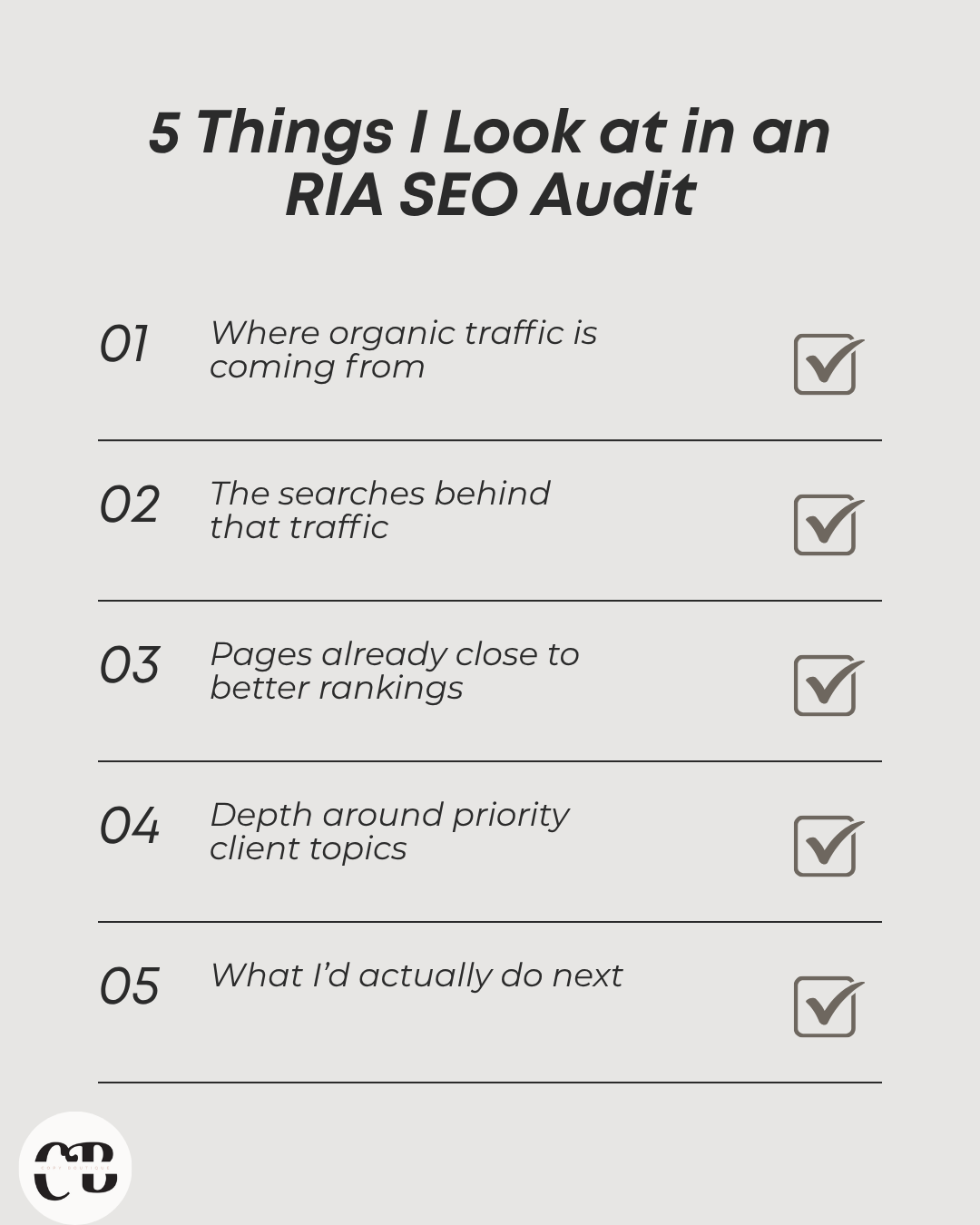
First, I Want to Know Where the Traffic Is Actually Coming From
One time, I opened a client’s analytics and found that four articles were bringing in almost all of the site’s organic traffic, which was immediately more interesting to me than the total traffic number.
From those four pages, we saw where Google was already giving the firm some credit. They also exposed how much of the content library wasn’t pulling its weight, even if they were the topics we were most excited to publish. If 40 or 50 articles are posted and 4 are doing nearly all the work, I want to understand what those 4 got right before adding another batch to the calendar.
So I’ll look at the landing pages first.
Which articles keep bringing people in?
Are older pieces still earning traffic months or years later?
Is one page responsible for an outsized portion of the web visits?
Which topics have several pages starting to gain traction, and which parts of the archive are barely getting seen?
Sometimes we find an obvious place to build. A handful of really successful articles can show us the subject Google already connects with the firm, giving us a head start on the next pieces. Other times, it shows that the site has become heavily dependent on one or two rankings and needs more depth around the areas the firm wants to be known for.
Either way, I’d rather learn from the pages already proving something than treat every new article idea like we’re starting from zero.
Then, I Look at the Searches Behind the Traffic
This is the point where we put a flattering traffic number to the test.
An article could bring in 500 visits a month for “what is capital gains tax.” Fine, but I’d personally get much more excited about a firm starting to show up for “retirement planning for oil and gas executives in Houston,” even if the search volume is a fraction of that.
So I spend a lot of time in the actual queries. I want to know which searches are gaining impressions, or which ones are starting to move up the rankings. From this data, we get to see what the audience wants more of, and can validate that information to see if it fits with our target demographic.
When it comes to a financial advisor’s SEO, I care much more about that than squeezing the biggest possible number out of the traffic chart. I’d rather see 50 people coming from a search around a problem the firm solves than 5,000 people looking for a definition.
I Don’t Assume the Next Move Is Another Article
Sometimes the most useful thing I find in an audit is an article sitting at position 8, 11, or 14.
It already has a foothold. Google is showing it for the right search, people are seeing it in results, and a better title, stronger section, fresher information, or a few well-placed internal links may be enough to push it further.
Older content can have some great potential. I’ve seen articles start picking up impressions for searches they were never intentionally built around, which usually tells me there’s demand worth paying attention to.
So before I add another topic to the editorial calendar, I look for pages that have already gained some traction. Sometimes the quickest SEO opportunity is sitting in the archive waiting for another pass.
I Look for a Body of Work Around the Clients You Want More Of
If a firm wants more business-owner clients, I’ll look at how much of the website actually reflects that.
One article on selling a business gives Google one page to work with; a library that covers the decisions surrounding a sale gives it a much fuller picture of that firm’s expertise. That might include planning for the tax bill, dealing with concentrated wealth afterward, deciding how much liquidity to keep, or figuring out what retirement looks like once the business is gone.
The same test works for executives, physicians, families dealing with an inheritance, or any other audience your firm wants to reach.
I’m looking for enough depth that the topic feels like part of the firm’s actual body of work, rather than something that happened to land on the editorial calendar once. If the website says business owners are a priority and the content library barely speaks to them, that’s usually an obvious place to build.
I Follow the Search Visitor Into the Site
Once someone lands on an article from their Google search, I want to see whether the site gives them a natural reason to stick around.
Maybe the article leads into another piece on the same planning issue, or maybe the reader clicks through to the advisor who works with clients in that situation or visits the service page to see how the firm approaches it.
That tells me something about how well the content fits into the rest of the website. A good search article can bring the right person in, but the surrounding pages should make it easy for that person to learn more about the firm from there.
I’m not trying to prescribe one perfect path through the site. What I am doing is looking for evidence that organic visitors have somewhere useful to go once Google gets them through the door.
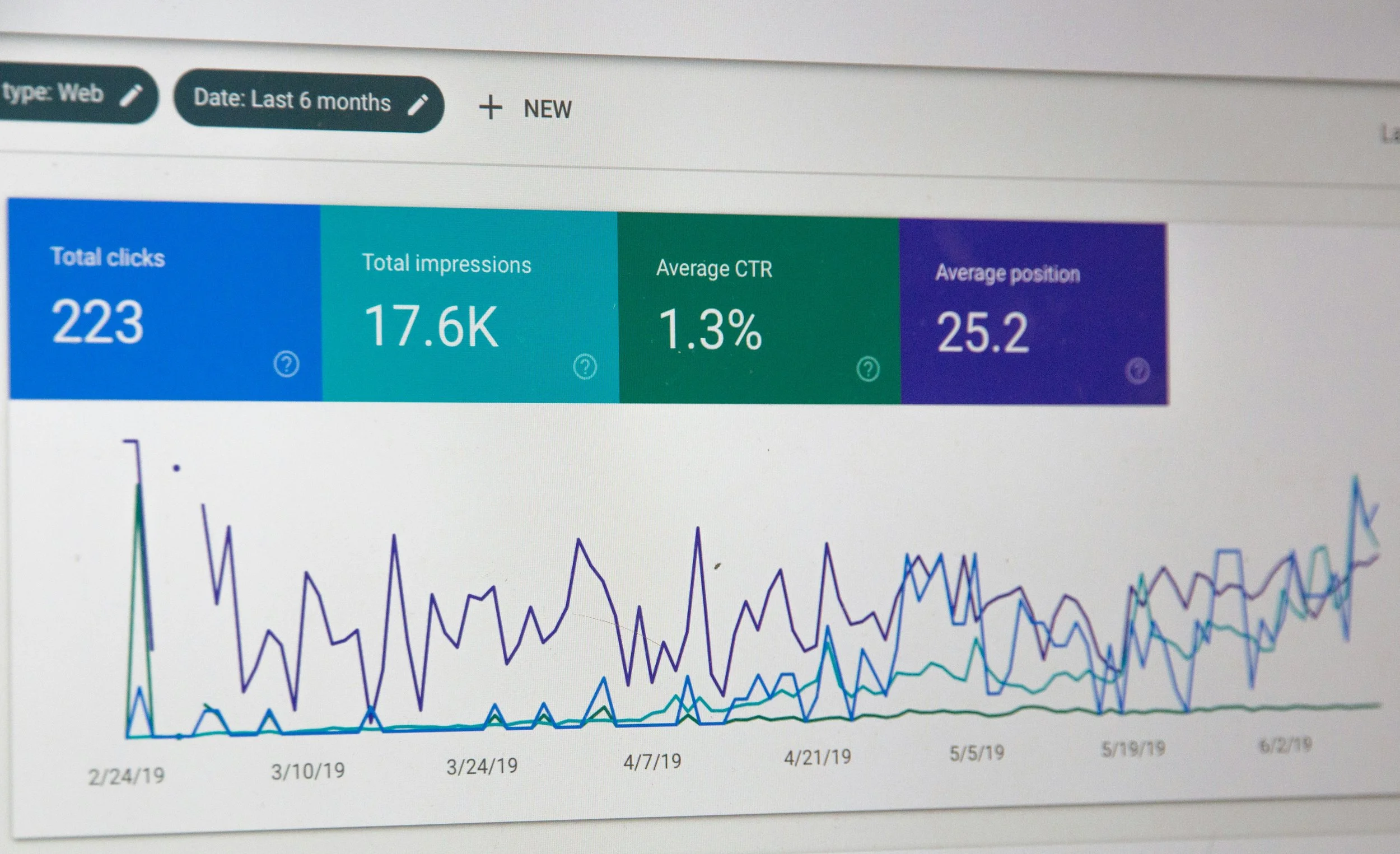
Then, It’s Time to Check the Boring Stuff
Sometimes the SEO problem is much less dramatic than the strategy deck can make it sound.
A great article can be buried six clicks deep behind a vague title with zero internal links. Two posts may be competing for the same search, or an older piece could still be ranking with information that’s years out of date.
This is where I look at things like:
titles and H1s
internal linking
overlapping or duplicate content
outdated articles
weak or missing metadata
pages that are difficult for search engines to find or interpret
These fixes aren’t especially glamorous, but they can help you get the value that’s already sitting on the site. Before I recommend a big new content push, I want to make sure the existing library isn’t being held back by something embarrassingly easy to fix.
Finally, We Decide What’s Worth Doing Next
An audit isn’t doing much for you if the end result is “SEO needs work.”
By the end, I want to know where I’d actually spend the firm’s time and budget next. Usually, this falls into a few buckets:
Build on: Topics where the firm is already earning relevant visibility and has room to become much more prominent.
Improve: Articles that are close to stronger rankings or have started picking up qualified searches.
Connect: Good content that’s sitting there by itself and could benefit from stronger internal links or a clearer relationship to the rest of the site.
Create: Searches and client questions the firm should have a credible answer for and currently doesn’t.
Retire or consolidate: Older pages that overlap, compete with each other, or have outlived their usefulness.
That’s what gives me the beginnings of an actual SEO plan. I can see where the firm already has momentum, where a relatively small update could pay off, and where there’s a big enough gap to justify creating something new.
By the end, I should be able to say, “Here’s where I’d start,” and have the data to back it up.
Final Thoughts
I want an audit to leave me with a solid opinion.
After looking through the rankings, search queries, and content library, I should be able to point to the part of the site I’d work on first and explain why it deserves priority. Sometimes there’s already a page getting close to a much better position. Other times, the data shows us that a topic the firm cares about barely has a presence in search yet.
The part I focus on most: turning everything I found into a call on where the next round of effort has the best shot.
I work with RIAs on financial advisor SEO and content, including this kind of audit work as part of ongoing engagements. If you’re looking for someone to take ownership of what your firm should be found for and build the content around it, schedule a call to see how I can help.
